| |
 Now Released - Latest

[Latest Updates]
[Standard Features]
"This
is the Best TBDP©/VBDP© release ever!"


 Description Description
[back to top]
Features
[back to top]
Analysis
[back to top]
Reports
[back to top]
Support:
- “With TBDP® and VBDP®, you’re not just
getting powerful tools - you gain direct access to fast, personal
support straight from the developer, backed by decades of hands-on
design and performance experience to help you get the most from your
boat.”





- Fast, expert, personal support directly from the developer, hands-on
guidance beyond software troubleshooting
- Direct email
and telephone support with typical responses within 1 business day
- no ticket queues or forum delays
- Corporate-level tech support
- Continuous
software
updates, clear changelogs, ability to request new features or bug
fixes. All project files from all previoius versions are
natively compatible with new update versions.
- Professionally written, up-to-date manuals
cover every input, output, and explain
both software operation and the underlying principles
- Step-by-step
video tutorials
for beginners and advanced users featuring real design examples
- Extensive documentation including
white
papers, research
papers, design guides,
example designs,
and performance tips
- Context-sensitive
on-line
Help screens
- User-friendly features like hover-over input tips and estimated
value buttons to guide data entry
- Sample
designs and templates for common hull configurations
- Interactive input validator to flag common errors before they cause
issues
- Setup wizards for key design features/inputs
- “This is the only software I’ve ever used
where support actually improved my design.” - [GRW,
CA]
[back to top]
System
Requirements for TBDP©/VBDP©:
- Computer: 32-bit or 64-bit Intel or AMD processor
- Operating System: Windows® 11/10/8/7
- Drives: CD Rom drive or USB drive (required for installation); Hard
Disk Drive (HDD). The TBDP©/VBDP© program requires approximately 200
MB available HDD disk storage space to install.
- Memory: 100MB of available RAM required to run
- Video: TBDP©/VBDP© will operate best with video display screen 1280
X 768 pixels or higher; DPI setting of 96dpi (100%) for viewing on HD
monitors. High-DPI displays are automatically accomodated, recommended
to 168dpi (175%). Ultra High Definition (UHD) and 4K monitors are accomodated.
Not compatible with Ultra-Wide monitors, screen splitting.
- Europe/Asia/SA Users - The TBDP©/VBDP© should be operated with Windows
REGIONAL & LANGUAGE SETTINGS set to ENGLISH (US).
- Printer: Any Windows® compatible printer
- Sound: Integrated audio processor or equivalent sound card
- TBDP©/VBDP© software is intended for installation on Windows®
OS (Win11/10/Win7/8) on a single-use computer. Not intended
for network/server installations.
- single-user license, transfer or resale not permitted.
[back
to top]
Why
AeroMarine Research and TBDP©/VBDP©?
- Over 40 years of development and real-world testing, TBDP©/VBDP©
is a trusted,
time-proven solution for designing/optimizing powerboat performance
- Lifetime personal software personal
software license (no annual fees).
- No CAD experience required.
- More flexible, more capable, more features than other generic software
×
Easy To Read Results
1 - Easy to understand results with over
detailed data points and
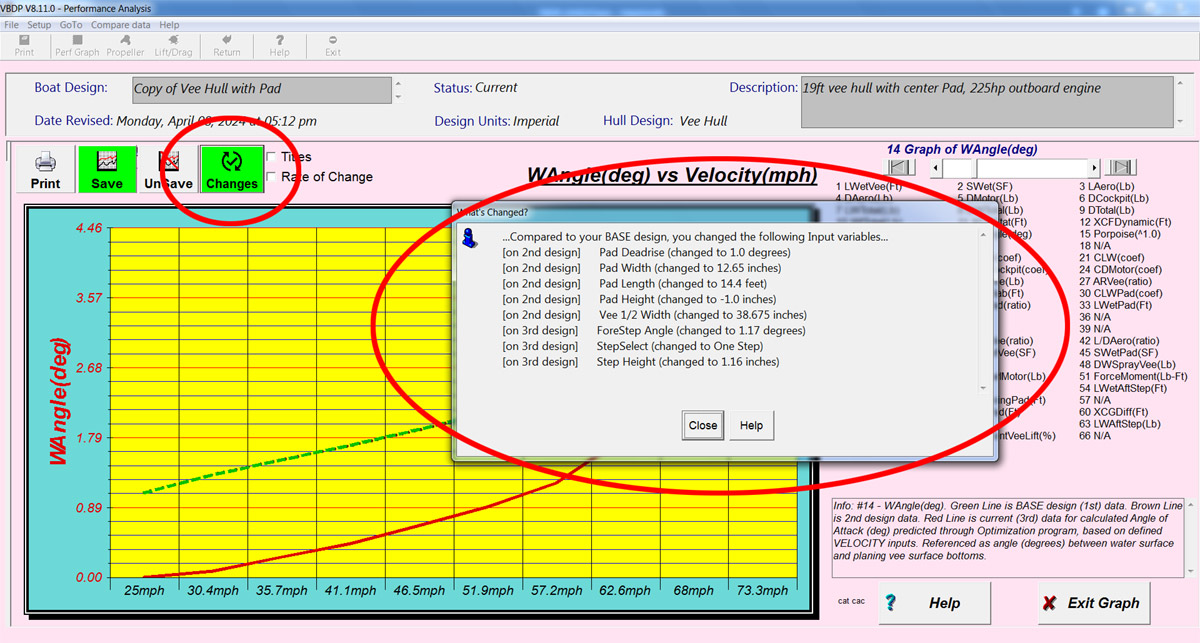
graphs illustrating lift, drag, power requirements, trim angles, acceleration,
elapsed time, center of pressures, and more.
2 - No need to interpret complex flow distribution paths
or decode pages of CFD numbers to see how your boat will behave.
TBDP reports accurately in
Performance and Stability data tables and graphically in
Performance Graphs
3 - TBDP/VBDP automatically determines the Trim Angles required
for each velocity, throughout the entire operating velocity
range. You don't have to test every velocity or combine loads
for different contributing forces.
4 - The AI-based
Performance Analysis Report Wizard explains what
the results mean in plain words, and also provides actionable
Optimization tips in key areas that it determines should be
of interest.
5 - Integrated Modelling - TBDP/VBDP automatically solves
the constantly
changing inter-related influences of (a) Aerodynamic
forces (aero lifting surfaces, tunnel lift, including 'ground-effect',
deck lift, deck/cockpit appendage drags, cockpit cavity drag,
etc); AND (b) Hydrodynamic forces from all contributing elements
(planing surfaces, lower unit/drives, steps, varying deadrise,
wetted areas, lifting strakes, spray rails, trim tabs, etc);
and (c) Balances the interactions of each force with each other,
for accurate lift, drag, stability, and porpoising predictions.
You don't have to do multiple modelling runs that simulate
or combine different loading situations (water, aero, trim angles,
engine heights, etc)
×
TBDP©/VBDP© Saves $000's vs trial-and-error
TBDP©/VBDP© makes performance optimization easy and fast,
comparing different design alternatives with the 'click
of a button'.
TBDP software is a tremendous advantage, saving $000's
compared to other methods of design
[Mussafa Ahmed, Naval Engineer, UAE]
This (TBDP) program saved us many hours of testing, I
wish I had this program 20 years ago when we where running our
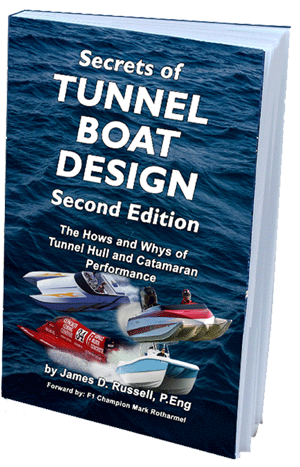
bigger boats. I would recommend TBDP software and STBD Book
to anyone
[Dominick Kuhl, Frazee, MN]
On or off the water, AeroMarine Research’s Tunnel Boat
Design software is a performance-predicting program that is
more than worth the price. There’s just nothing like it anywhere
else.
[Greg Terzian, Scream and Fly magazine]
×
TBDP©/VBDP© vs Generic CFD software
1-"Most commercial marine design software focus on generic
CAD tools and often fall short with specialized capabilities
for detailed powerboat performance analysis, and can be not
very accurate and hard to interpret.
2-TBDP©/VBDP© is designed specifically for powerboat design
and analysis to accurately define performance of boat hulls.
3-TBDP©/VBDP© is designed to run faster, and operate with much less computing power than generic CFD/CAD software.
4-TBDP©/VBDP© automatically balances all of the hydrodynamic
forces and aerodynamic forces. No need to model and calculate
each separately or to manually adjust inputs for other (air
or water) mediums or influencing forces (trim angle, tunnel
lift, etc).
5-Dynamic Interaction of air/water medium and associated
interdependant aerodynamic/hydrodynamic forces is automatically
balanced by TBDP©/VBDP© software.
6-Gives overall resultant loading results (example hydrodynamic
lift, aerodynamic lift, etc.) for entire hull - the complete
answer - rather than giving hundreds of loading values that
must be interpreted to consider a total hull lift, resistance
and dynamic stability.
7-Automatically determines Trim Angle, based on balanced
forces from all sources, automatically adjusted for overall
hull trim angle. No need to do multiple trials at different
trim angles and try to interpret results.
8-Details count... TBDP©/VBDP© accounts for... lower unit
designs, complex steps loading, whisker spray influences, spray
rails, lift strakes, cockpit drags, cavity drags, engine cowl
drags, multiple and variable lifting surfaces (center-pod, vee-pad)
- all with one-click Results.
×
Power boat design software Price Comparisons
"Most commercial marine design software focuses on generic
CAD tools and often lacks the specialized capabilities needed
for accurate, detailed powerboat performance analysis - making
results hard to interpret and less reliable."
- TBDP©/VBDP© - Tunnel/Vee hull performance prediction - US$499
- Lifetime License, no addins required
- *MultiS* - CAD modeling + hydrostatics - US$4000+ - Perpetual
license
- *MHydro* - CAD + hydrostatics - €1,241/year - Subscription
- *AutoS* - CAD hull design, hydrostatics - US$3200/year -
subscription
- O*3D+R* - CAD modeling + resistance analysis plugins - US$4,995/year
- subscription
[Note: Price checking in 2025 might not be accurate, may
not include some required plugin modules + $'s, all capabilities
may not be listed]
×
Why Testing at One Velocity is Not Enough
"Performance measures and Hull Balance at 1 test velocity is insufficient to determine any conditions except at that 1 velocity. "
- Top speed determination is not helpful if the hull becomes unstable at a lower velocity - can't get there safely! We need to know!
- Key Stability indicators like 'Hump Zone Transition',
'Porpoising',
'Dynamic Stability'
are evident as CHANGES between 2 velocities - but at what velocity do the changes occur? We need to see Results through the full velocity range to determine real-life performance.
- TBDP/VBDP Dynamic Stability graph shows results from start velocity to final velocity, shows all instabilities.
- Optimum Step Performance can be optimized at only one velocity; ideal step location is a function of velocity,
all lift/drag forces/locations, etc; but can’t change a fixed step location
- Must assess trend changes as velocity increases, from 1 velocity to another velocity, to predict a developing instability.
How Other software handles - do an analysis at a 'guess' velocity, check a Performance value; if not good, then change design and then run analysis over again.
OR...
How TBDP/VBDP handles - do ALL analysis at ALL velocities automatically; show each Performance trend thru the full velocity range, all together, on one
graph - trends are evident, instability velocities are visible, no guessing.
×
Lateral Dynamic Stability
"New dynamic lateral stability analysis by AeroMarine Research delivers a major step forward in predicting a boat’s true stability behavior across all speeds, from the first moments of planing to the highest performance speed ranges. "
- Developed through extensive hydrodynamic research, modeling and full-scale testing
- NOT just a STATIC stability test (FULL analyis methods must consider the instabilities caused by DYNAMIC forces on planing tunnel hull, vee hull or vee-pad hull).
- TBDP/VBDP 'DSI indicator' captures the complex interactions of roll forces, damping, geometry, and pressure fields within a single, unified framework using 'DSI indicator'.
- TBDP/VBDP Dynamic Stability graph shows results from start velocity to final velocity, shows all instabilities.
- Dynamic Stability Index (DSI) measures combined effects of roll damping and roll stiffness. Lateral dynamic stability is influenced by hull geometry and hydrodynamic forces. DSI is velocity-adjusted representation of Stability Factor, SF, geometric indicator of roll stability and Roll Damping Ratio (DR), dynamic measure of hydrodynamic damping of roll motions.
- FULL analyis methods of 'DYNAMIC LATERAL STABILITY' can predict 'chine-walk', 'dynamic track rolling', 'oscillations', 'turning hook', 'bow steer', all as velocity increases thru operating range.
How Other software handles - Other CAD software "only touches 'static stability' modeling" (only helpful while you're tied to the dock).
OR...
How TBDP/VBDP handles - captures the complex interactions of roll forces, damping, geometry, and pressure fields within a single, unified framework - all through entire velocity range.
- Despite complexity of analysis, 'Dynamic Stability Index' makes it easy for users to assess stability quickly and confidently.
- More advanced analysis, more advanced results (not generic CFD)
- Easy to Read, 'Real-World' Results
- No additional plugins or external CFD post-processors required
- Single project file used across all design, hydrodynamic, aerodynamic,
stability, performance and graphics results.
- Saves $000's vs 'trial and error'
- Lower $ cost vs other generic software suites
- Much faster workflow than other generic software suites
- Excellent
media
Reviews and
testimonials
- AR® maintains ongoing, continuous
research,
widespread
publishing
presence.
- Vast
published
papers, regular
software
updates, demonstrated commitment to excellence, continuous development,
and customer service.
- Online
Instructional
Videos
- Outstanding
client support (call
us and see for yourself!)
- Extensive, user-friendly
documentation
and
Help
functions
- Low cost for combined software package for tunnel boats and vee
boats
|
|
What's new
09/23/26
Released!
(Windows 10/8/7)
In
- DesignWizard w/
Std Design Templates
-
Input controls
-
Performance Data Points
-
Performance Graphs
- Optimizaton Report w/Recomendations
-
Lwr Unit Wizard w/
OEM Drive specs
- MotorWizard w/
OEM Engine specs
-
page printed User Manual
Analyze Performance for...
 Max
Limiting Velocity (top speed) Max
Limiting Velocity (top speed)
Acceleration,
Elapsed Time
Trim
Angles
Dynamic
Stability
Porpoising
Required
Power useage
Economy
Analysis
Aerodynamic
performance
All
contributing Lifts, Drags, Moments
Wetted
Lengths/Area
CG
determination
Aerodynamic
Performance
Steps Performance
Propeller sizing
Cockpit drag
Forces analysis
Lift/Drag Ratios
Lift/Drag coefficients
Effective
Planing widths
Lift
Force CP locations
%Pod/Pad
Lift
%Sponson/Vee
Lift
Strakes
Wetted
Consider Performance effects of...
Bottom
design, widths
Bottom
surfaces shapes
Tunnel
design
Vee
design
Deadrise
angles
Aerodynamic
effects
Steps
design
All
Weights & distributions
Tunnel
centerpod
Vee-Pad
sizing/optimize
Lower
Unit design
Engine
height
Multi-Engine
effects
Cockpit
design
Spray
rails
Lift
strakes
Trim
Tabs
wind
effects
weather
conditions
HOW FAST DOES MY BOAT GO?
TBDP V8, "How Fast Does My Boat Go?" Analysis video
AUTO 1-2-3 PERFORMANCE ANALYSIS
TBDP V8, "Auto 123 Performance Analysis"
video
QUICK DESIGN WIZARD
TBDP V8, "Quick Design Wizard" video
ECONOMY PERFORMANCE ANALYSIS
"Economy Performance Analysis" video
LOWER UNIT DESIGN PERFORMANCE ANALYSIS
TBDP V8, "Lower Unit Design" Performance
Analysis video
|