|
|
|
 |
Advanced Aerodynamics and Hydrodynamics for Powerboats |
| Performance Boat design and setup secrets for Recreational tunnels, Offshore Cats, Racing tunnels, Fishing/Utility hulls, Vee and Vee-Pad Hulls, Bass Boats | |
| Home New About Us Free Articles Technical Articles TBPNews Archives FREE Downloads Research Contact Us | |
Testimonials
What Others Say
Join TBPNews
Advertise
Search
Buy Now

  
|
|
| TBDP©/VBDP© Porpoise Regime Analysis | ||
| Get complete article by email request: | Share: | |
| BREAKTHROUGH! | ||
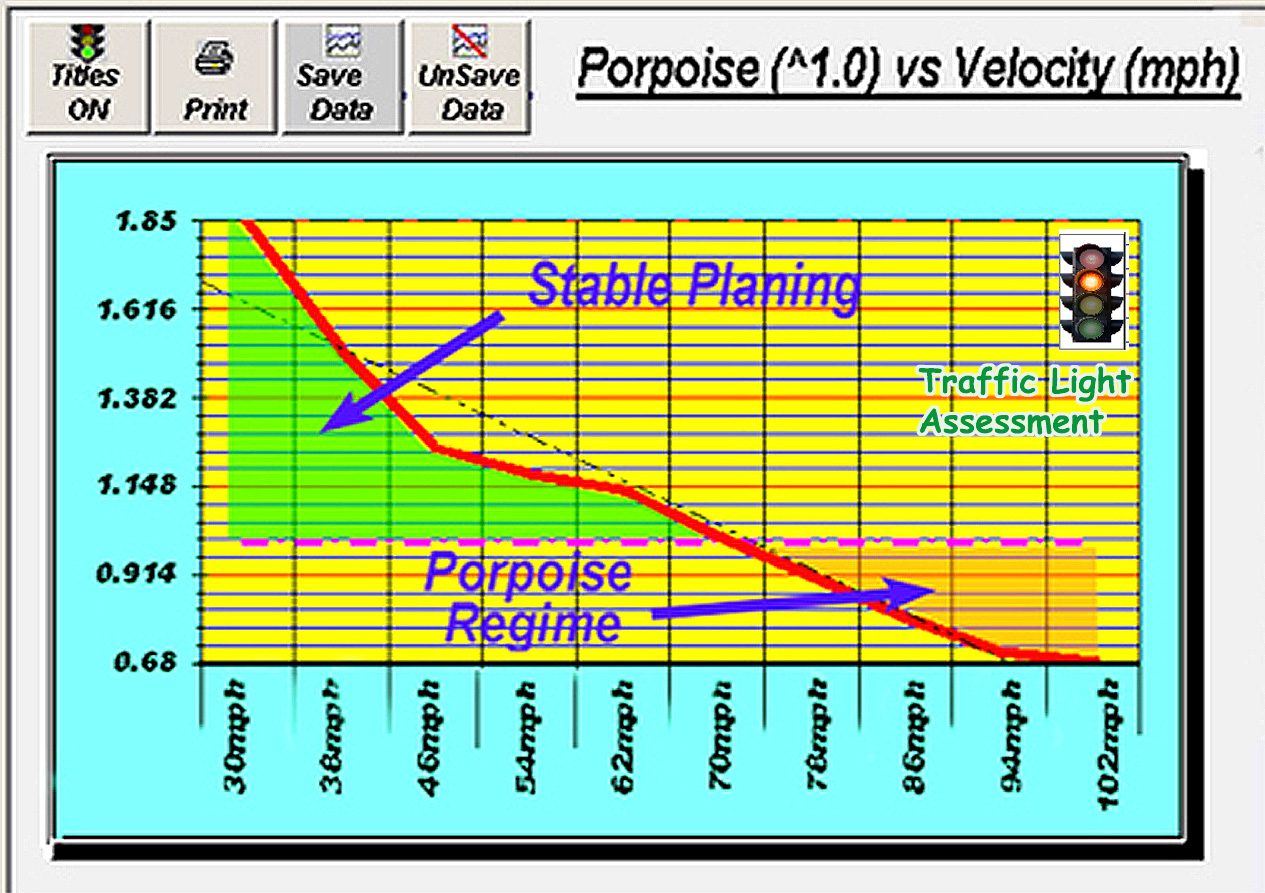 Figure 1- Porpoising is the cyclic oscillation of a boat in pitch and heave, of sustained or increasing amplitude, occurring while planing on smooth water. 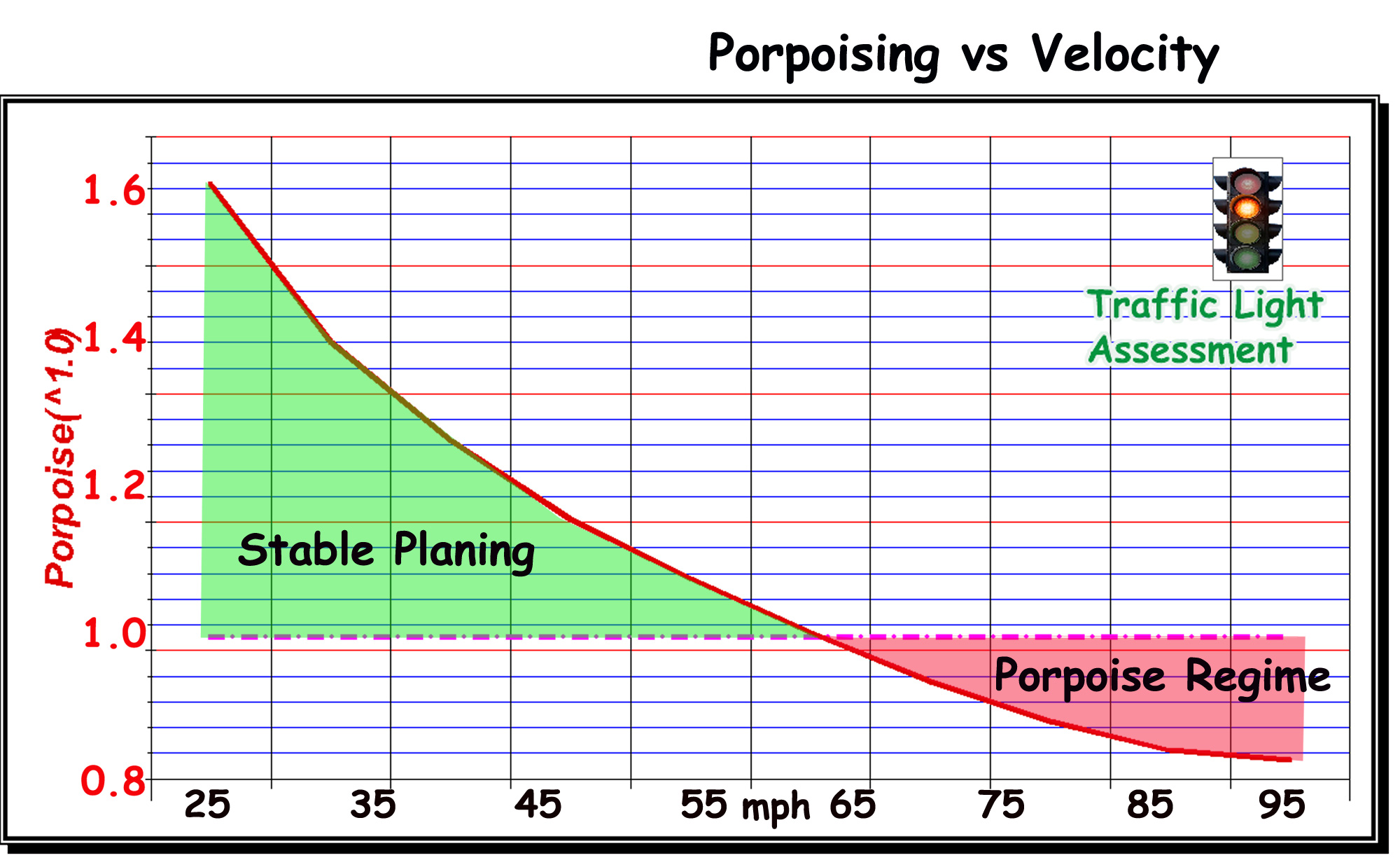 Figure 2- TBDP©/VBDP© graphic output shows the velocity at which your hull configuration experiences instability in Porpoise Regime and susceptibility to Porpoising. |
Porpoising can affect any performance hull design, but when will it happen? under what conditions? how do we fix it? Porpoising Analysis predicts onset of longitudinal insabilities that initiate Porpoising, and show the speed when it will occur, and more.
We have developed a new analysis tool in the TBDP©/VBDP© software! XPorpoise is an engineering tool
developed by AR® that helps predict your hull's inherent instabilities
leading to porpoising.
How To Evaluate Porpoising Stability:
NOTE: Stability indicator results are not ONLY value-based, see the 'trend-based' ASSESSMENT notes provided in 'Performance Summary Report' and the 'TRAFFIC LIGHT' symbol on this graph. CLICK on 'TRAFFIC LIGHT' symbol for DETAILED STABILITY REPORT. [see xPorpoise indicator on Graph #15] Read on for explanation of these analytical indicators... What is Porpoising? Porpoising is the cyclic oscillation of a boat in pitch and heave, of sustained or increasing amplitude, occurring while planing on smooth water. Picture a porpoise leaping through the water and you get the image of what it’s like in a powerboat. Severity can range from an uncomfortable ride to aggravating or even dangerous. From an engineering perspective, porpoising is a dynamic longitudinal instability involving cyclic pitch and heave oscillation during planing operation. The onset and severity depend on the interaction of hydrodynamic lift, aerodynamic lift, trim angle, hull geometry, damping, inertia, and dynamic load distribution. |
|
|
AR® Advanced Porpoising Analysis:. Our technique extends the quasi-static Savitsky-based "Trim Stability Limit Test", by also examining a "Dynamic Pitch Stability Test (Λ-based)" analysis: 1) 'Trim Stability Limit' - the 'Net Dynamic Longitudinal Force Centroid' technique (modified Savitsky & Day/Haag method) predicts the Critical Porpoise Trim Angle (CPA). This identifies the stability boundary where increasing trim causes lift growth and center-of-pressure movement to become self-reinforcing, reducing the hull’s ability to return to equilibrium - so the bow tends to keep rising rather than returning to equilibrium. 2) 'Dynamic Pitch Stability Index' (Russell) - includes time-dependent effects such as inertia and damping to evaluate when the hull’s dynamic pitch response resulting from the interaction of pitching moments, inertia, restoring forces, and damping characteristics, is sufficient to resist small disturbances. The Pitch Stability Index (C_MCG) assesses dynamic restoring behavior and is normalized to produce a dimensionless pitching moment indicator, and determines:
[See more about - Longitudinal Pitch Stability]
Using both methods together allows prediction of both the instability onset condition and the subsequent dynamic behavior of the hull, including whether oscillations will damp out or amplify once initiated. Either or both of these conditions can cause porpoising onset.
Each condition is evaluated across the complete operating velocity range using continuously varying hydrodynamic and aerodynamic loads, rather than isolated or single-point conditions. How
it works:
By analysis of a hull's
design and performance characteristics and comparison to the CPA
for each velocity in performance range, TBDP©/VBDP© can predict
when the hull is susceptible to porpoising and when it is performing
in a stable regime.
Making it Easy: TBDP©/VBDP© presents a full range of reporting information that makes the results and recommendations easy to understand. For each of the Stability measures, the software does ALL the work behind the scenes, and gives both DETAILS and also gives the 'GOOD/NO GOOD' summary of all considerations. [Check out 'Easy Results View' here] |
||
|
The XPorpoise analysis is presented in standard TBDP© and VBDP© output and in graphic analysis format. It's simple to interpret when the hull is in the "Porpoise regime" or in the "Stable regime"....AND simple to change setup or design features with TBDP©/VBDP© Ver 8 to make the hull less susceptible to porpoising. (While several design or setup or operating parameters influence the hull's susceptibility to porpoising, a hull with MORE deadrise or LESS trim angle is less likely to experience onset of porpoising.) Establishing the critical porpoising limits is more complicated when we must include the interaction of sponsons (tunnel hull) or vee surfaces (vee hull) with a centerpod or vee-pad hull configuration. Porpoising analysis is particularly complex when dealing with stepped hulls. TBDP© and VBDP© now analyzes the influence of complex stepped hulls on the onset of porpoising for tunnel hull, vee hull, centerpod, and vee-pad hulls.
|
||
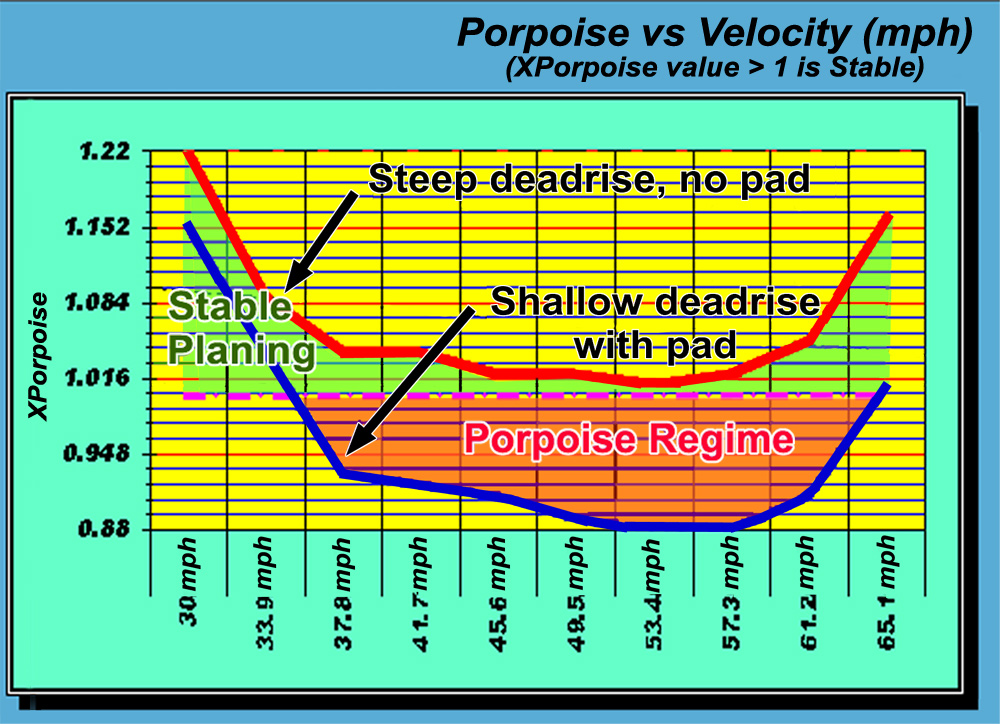 Figure 2 - VBDP© graphic output shows the differences in vee hull bottom designs that can contribute to instability in Porpoise Regime and susceptibility to porpoising. |
TBDP©/VBDP© analyzes the porpoising stability of your hull design/setup and presents the analysis for your design for operation in "stable planing regime" or "Porpoise instability regime". When your hull is in the "stable planing range", the hull is less likely to experience porpoising. When your hull is in the "Porpoise instability regime", it is susceptible to porpoising. The ability for TBDP©/VBDP© to present graphic view of XPorpoise analysis for TWO design alternatives simultaneously, makes comparative evaluation quite easy. (Note view in Figure 2 that shows "shallow deadrise with pad" vee hull, compared to "steep deadrise, no pad" vee hull designs - and their relative susceptibility to porpoising in "Stable Planing" regime (less susceptible to porpoising) or "Porpoise Regime" (more susceptible to porpoising). |
|
|
TBDP©/VBDP© and the XPorpoise analysis can identify the susceptibility of your hull to porpoise and show what speeds that it will occur. So, what can I do about it? Porpoising is a function of the lift generated by your hull, the deadrise of your running surfaces, and the trim angle that is needed to get that lift. If the hull design/setup is 'prone to porpoising', the onset of porpoising will start at a velocity that triggers a change in dynamic center of gravity (often the hump zone). The resolution to a porpoising problem with a hull design is most always addressed by causing the boat to run with less trim. If a boat is porpoising at a given speed and load, lowering the trim angle will reduce or eliminate the porpoising. There are several ways to get there, but the bottom line is to reduce the trim angle at the velocity of porpoising onset. Even if the hull design is operating in the "Porpoising Regime" through a full range of velocities, reducing trim in some way will improve or resolve the problem. Resolutions to an existing porpoising problem: -Reduce Trim Angle -Change Static Weight Locations -Change Dynamic Forces location -Clean up Hull bottom condition -Optimize Propeller Selection -Design with Higher Deadrise (bottom surfaces) -Trim Tabs Porpoising Analysis Sensitivity: 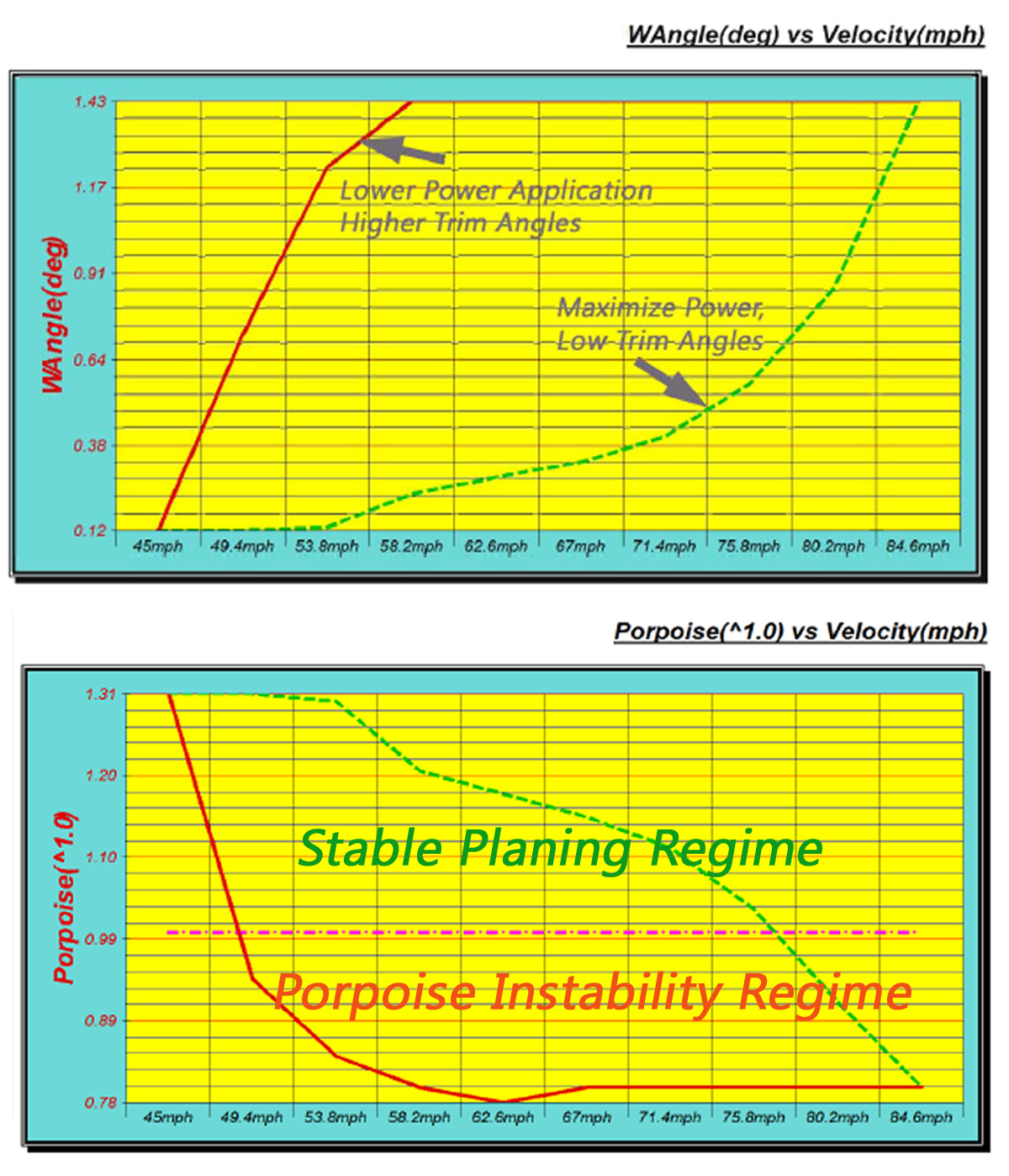 Some boat designs and
setups are quite sensitive to trim angle, as it applies to
the susceptibility to porspoising onset. When a hull is set up to be
able to utilize full power, then sufficiently low trim angles
can be achieved and the hull can operate in ‘stable planing
range’. Some boat designs and
setups are quite sensitive to trim angle, as it applies to
the susceptibility to porspoising onset. When a hull is set up to be
able to utilize full power, then sufficiently low trim angles
can be achieved and the hull can operate in ‘stable planing
range’. It is important to note that in operation, you may have the boat set to run at lower power levels and different trim angles during some parts of your speed range. If setup is unable to take advantage of full power for some reason (driving, propeller selection, engine height, engine trim settings, etc), then higher trim angles can move the hull into ‘Porpoise instability regime'. You can illustrate this with TBDP©/VBDP© by testing with varying trim angle settings, to view resulting porpoising results and hence, the sensitivity of the boat to trim angle settings as it affects the onset of porpoising. this 'sensitivity' analysis is a good design approach with hull designs that are likely to be more sensitive to trim angle (eg: lower deadrise planing surfaces or higher trim angle operating requirements). PORPOISING
ANALYSIS VIDEO |
||
Research results now included in performance analysis by TBDP©/VBDP© [more about AR's research more about AR's publications and technical articles/papers] |
||
 about Jim Russell